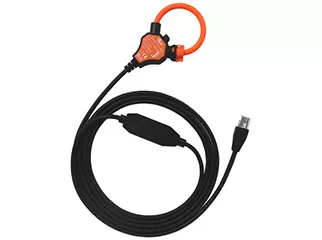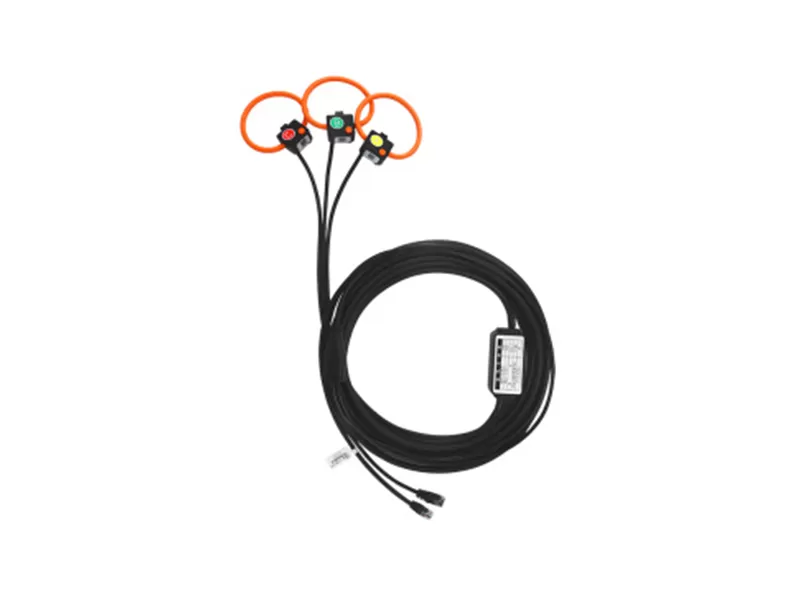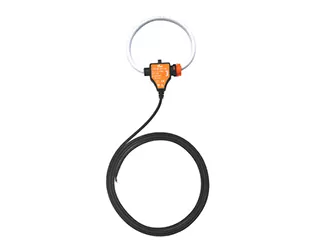

In industrial power systems, electric vehicle charging, power quality monitoring, and high-current fault detection, accurate current measurement is important for system stability and energy efficiency. A key limit of traditional current transformers (CTs) is magnetic core saturation. This problem is worse when the current is very large or when the load conditions are complex.
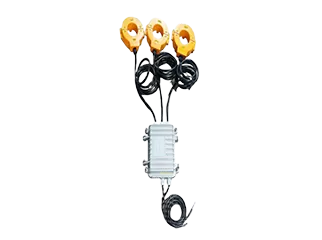
Based on TFY’s engineering experience, the reinforced high-current three-phase flexible Rogowski coil (without an integrator) offers a different way to measure current. It removes magnetic saturation by design, so it can give more reliable current data in harsh conditions.
Traditional CTs use a ferromagnetic core. This common design has some built-in problems:
Flux density limit: the core can only handle a certain magnetic field. If it goes above that level, the core saturates.
Overload and DC offset: large current, inrush current, or DC parts can quickly cause CT saturation.
Waveform distortion: after saturation, the output cannot match the primary current well.
Remanence (residual magnetism): residual magnetism can build up over time. This makes saturation more likely and lowers accuracy over the long term.
These problems can reduce metering accuracy, reduce protection reliability, and increase safety risk.
A reinforced flexible Rogowski coil works in a different way:
Air-core structure: it has no iron core and no ferromagnetic material.
Linear response: its output is proportional to the rate of change of current (di/dt), so it stays very linear.
No hysteresis and no magnetic limit: because it has no magnetic material, it does not saturate.
So this is not just “better against saturation.” It does not saturate at all.
| Feature | Traditional Current Transformer (CT) | Flexible Rogowski Coil |
| Magnetic saturation | Often saturates under high current | No saturation at any current level |
| Waveform accuracy | Distorts during overload | Keeps waveform accurate |
| DC immunity | Weak; DC offset can cause error | Strong against DC components |
| Remanence | Yes; affects long-term accuracy | No remanence |
| Dynamic range | Limited | Very wide |
| High-current capability | Limited by the core | Up to 100 kA, no saturation |
| Accuracy class | Standard classes | Meets IEC 61869-10 Class .5S |
Accurate measurement at very high current
The reinforced high-current flexible Rogowski coil is rated at 100 A and can handle up to 100 kA. It can take fault current and short-circuit shocks without waveform distortion. So it fits high-load industrial systems.
Stable operation in tough electrical conditions
In systems with inverters (VFDs), EV chargers and mixed AC/DC loads, a non-saturating high current sensor helps maintain stable measurement under rapidly changing electrical conditions. A fully shielded design also reduces interference from external noise.
No remanence and no long-term drift
CTs can lose performance because the magnetic core retains residual magnetism. A rogowski coil current sensor does not have this limitation and can maintain Class 0.5S accuracy without remanence-related drift, making it suitable for continuous monitoring.
Wide measurement range
One flexible Rogowski coil can measure from small current up to 100 kA. This can reduce the number of sensor types needed.
From TFY project experience, the non-saturating design is very useful in these cases:
Power system protection: it gives accurate current signals for protective relays
Energy metering and monitoring: it improves data quality for energy management systems
Industrial safety: it works reliably during faults and transient events
High-current uses: substations, heavy industry, EV charging, and power quality projects
In EV charging, power grids, and industrial equipment, systems often need to run all the time and stay reliable. In these cases, this feature can lower risk and make the system easier to monitor.
Magnetic saturation is a major limit of traditional CTs. A reinforced high-current three-phase flexible Rogowski coil (without an integrator) removes the magnetic core, so it removes saturation. For high-current measurement, power quality monitoring, and reliable protection, it is not only a replacement option. It is also a clear upgrade in current sensing.